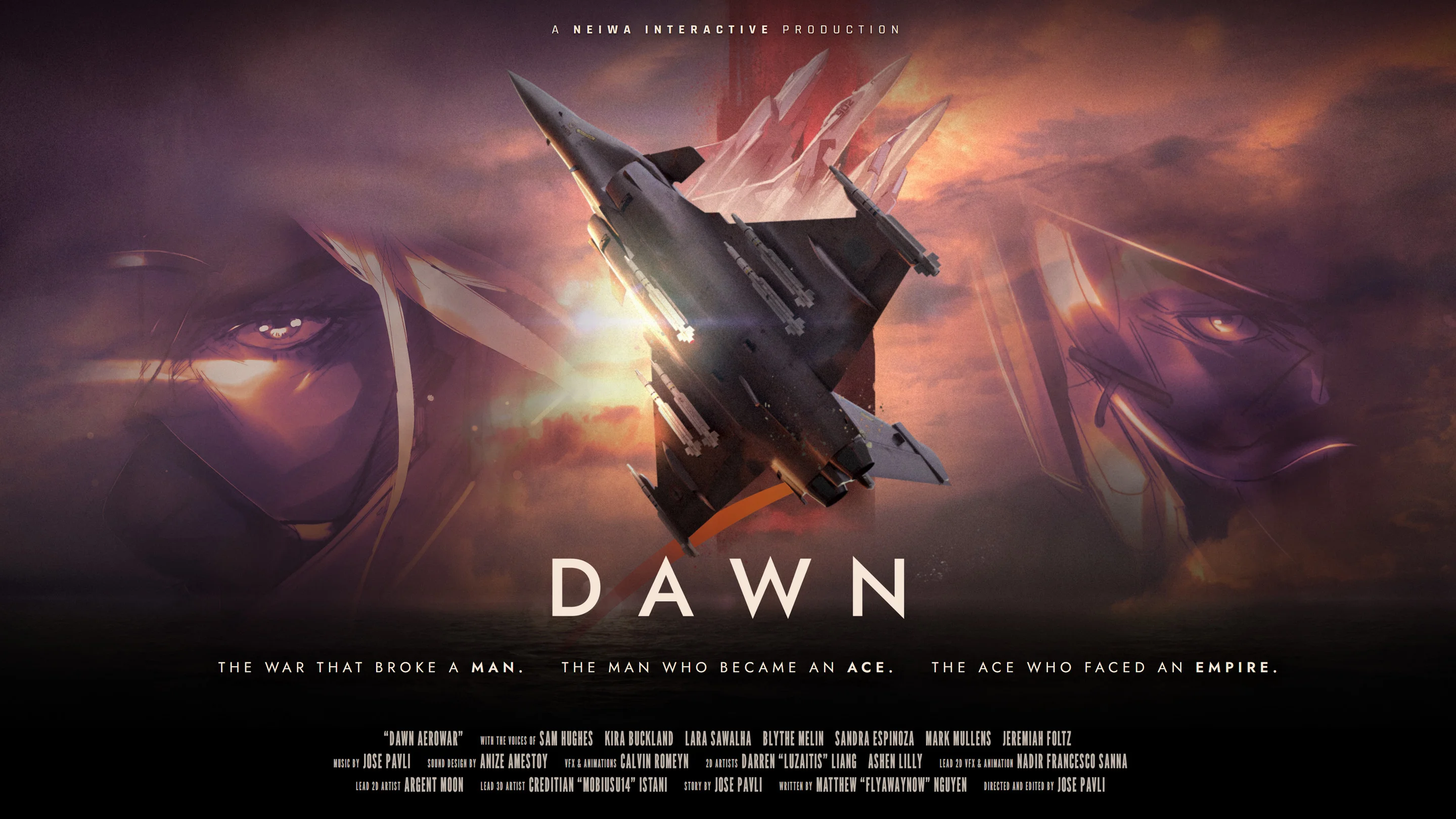
- Dawn Aerowar world: A cinematic war setting built around pilots, rival nations, and a final aerial mission.
- Story format: The project combines 3D animation, 2D artwork, voice acting, and interactive episode selection.
- Central conflict: Zodiac 1 faces a war involving the Free Nations and the Saal'Runa Empire.
- Key route: The narrative moves from the Northern Front through the Strait and Aegis Sea toward the capital.
- Current status: The Windows Steam release is planned for November 10, 2026.
What Is the Dawn Aerowar World?
The Dawn Aerowar world is a cinematic aerial-war setting presented through an interactive animated feature rather than a conventional flight simulator. Its identity comes from the combination of 3D aircraft animation, 2D character art, full voice acting, radio transmissions, military locations, and an original soundtrack.
The project is structured as approximately two hours of content divided into 12 episodes. Instead of focusing on equipment progression, competitive systems, or traditional mission mechanics, it presents a guided story about pilots operating during the final stage of a major conflict.
The official Dawn Aerowar website places the emphasis on an animated war narrative. The Steam product page identifies the planned Windows distribution, while the interactive features organize how viewers move through the story.
| World Element | Role in the Setting | What to Watch For |
|---|---|---|
| Aerial warfare | Establishes the scale and urgency of the conflict | Aircraft movement, formations, and battle zones |
| Pilot drama | Connects the military conflict to individual characters | Zodiac 1 and the Imperial aces |
| Radio transmissions | Adds tactical and emotional context | Orders, warnings, and battlefield communication |
| 3D animation | Presents aircraft, environments, and large-scale action | Flight scenes and cinematic combat |
| 2D artwork | Defines character presentation and visual identity | Portraits, expressions, and dramatic transitions |
| Interactive viewing | Lets viewers navigate the feature | Cinematic mode, episodes, and map selection |
Treat Dawn Aerowar as an animated war chronicle first. Its interactive tools support navigation and replay, while the setting is carried by characters, locations, and military events.
Cinematic War Story
The main experience follows a serious aerial conflict through film-like scenes, voiced dialogue, and dramatic battlefield movement.
Pilot-Centered Lore
Zodiac 1 and the Imperial aces provide the personal perspective needed to understand the larger war.
Mixed Visual Language
Three-dimensional aircraft and environments are paired with hand-drawn two-dimensional character presentation.
Chapter-Based Structure
The story is divided into 12 episodes, allowing viewers to follow the campaign in distinct narrative stages.
Story, War Route, and Major Locations
The central story follows Zodiac 1 during a final mission near the end of a major war. The operation involves a mysterious weapon and a route that crosses several important theaters. This structure gives the setting a clear geographic progression: the conflict begins at the Northern Front, expands through the Strait and Aegis Sea, and eventually moves toward the capital.
The story also reflects a clash between the Free Nations and the Saal'Runa Empire. The available material presents the Empire as the opposing military power, while Zodiac 1 represents the side carrying out the final operation. The setting therefore combines a broad national conflict with a focused personal mission.
| Location or Region | Narrative Function | Setting Significance |
|---|---|---|
| Northern Front | Opening theater of the operation | Establishes the intensity and military scale of the war |
| The Strait | Transitional route for the mission | Connects separate battle zones and increases operational pressure |
| Aegis Sea | Maritime and aerial theater | Expands the conflict beyond a single front |
| The Capital | Destination of the campaign | Brings the mission toward its decisive final stage |
| Free Nations | Protagonist-side political context | Frames the resistance and mission objective |
| Saal'Runa Empire | Primary opposing power | Defines the imperial threat facing Zodiac 1 |
The Final Mission
The final mission is the anchor of the narrative. It is not simply a flight from one point to another; it represents the last major operation of a conflict that has already shaped the characters and nations. The mission’s purpose includes protecting or escorting a mysterious weapon, adding uncertainty to the military objective.
This setup supports several recurring lore questions:
- Why is the weapon important to the balance of the war?
- What has Zodiac 1 experienced before the final operation?
- Why are the Imperial aces assigned to oppose the mission?
- How does the route toward the capital change the meaning of victory?
- What does the end of the war require from the pilots involved?
The Geographic Progression
The route is important because each region represents a different stage of the story. The Northern Front introduces the established war. The Strait and Aegis Sea broaden the scope, placing the mission in increasingly dangerous environments. The capital functions as the final destination, where military objectives and political consequences are likely to converge.
The available setting information confirms the mission route and major conflict, but it does not establish every ending detail. Avoid presenting unconfirmed conclusions about the weapon, the capital, or the final fate of individual pilots as canon.
| Story Stage | Main Focus | Best Lore Question |
|---|---|---|
| Mission briefing | Zodiac 1’s role and objective | What makes this operation different from earlier missions? |
| Northern Front | Established wartime pressure | Which side controls the opening theater? |
| Strait crossing | Movement between battle zones | What makes the route strategically important? |
| Aegis Sea | Expanded aerial conflict | How does the environment affect the operation? |
| Approach to the capital | Final escalation | What political or military result depends on success? |
Factions, Pilots, and Character Roles
The major characters in Dawn Aerowar are defined by their relationship to the aerial conflict. Zodiac 1 serves as the central pilot and mission unit, while Reaper, Freya, and Miracle are presented as Imperial ace pilots. Their roles create a clear opposing lineup without requiring the story to reduce every character to a simple combat statistic.
The three Imperial aces are especially important to the setting because they represent the Empire’s elite aerial presence. Their reputations help communicate that Zodiac 1 is not traveling through an ordinary patrol route. Each ace contributes to the sense that the final mission is being watched, challenged, and contested by experienced opponents.
| Character | Role | Faction or Position | Lore Function |
|---|---|---|---|
| Zodiac 1 | Central pilot and mission unit | Protagonist side | Carries the final mission and connects the story’s major locations |
| Reaper | Imperial ace pilot | Saal'Runa Empire | Represents elite opposition to Zodiac 1 |
| Freya | Imperial ace pilot | Saal'Runa Empire | Adds another dimension to the Imperial pilot roster |
| Miracle | Imperial ace pilot | Saal'Runa Empire | Reinforces the scale and quality of the opposing force |
Zodiac 1
Zodiac 1 is the narrative center of the project. The character’s importance comes from carrying the final mission across multiple war theaters.
Imperial Aces
Reaper, Freya, and Miracle form the known group of Imperial ace pilots connected to the conflict surrounding Zodiac 1.
Faction Contrast
The Free Nations and Saal'Runa Empire provide the political frame for the personal rivalry between opposing pilots.
How to Read the Character Conflict
The pilot conflict should be read through three layers:
- Military opposition: Zodiac 1 must operate against an organized Imperial force.
- Personal reputation: Ace pilots are not interchangeable units; their titles suggest experience and status.
- Narrative pressure: Every encounter increases the importance of the final mission and its destination.
The setting information does not confirm detailed biographies, exact ranks, or individual backstories for every pilot. A reliable wiki entry should therefore separate confirmed roles from future character revelations.
Use confirmed titles and faction roles when documenting the cast. Keep speculation separate from canon until official story material provides additional details.
Episodes and Interactive Viewing Structure
Dawn Aerowar is designed to be explored as a chapter-based animated work. The project contains 12 episodes and nearly two hours of content, giving viewers a structured way to follow the war story without requiring a traditional gameplay progression system.
The interactive format centers on viewing choices. The available descriptions identify Cinematic mode, episode selection, and a map interface for choosing chapters. These functions make the experience easier to navigate and revisit while preserving the film-like presentation.
Choose a Viewing Mode
Begin with Cinematic mode when you want the most guided presentation. This option emphasizes atmosphere, scene composition, voice acting, and the rhythm of an animated film.
Select an Episode
Browse the available chapter structure and choose the part of the story you want to watch. The 12-episode format separates the overall mission into manageable narrative sections.
Follow the Mission Route
Track the movement from the Northern Front through the Strait and Aegis Sea toward the capital. This route provides the clearest way to understand the story’s escalation.
Revisit Earlier Chapters
Use the viewing interface and map selection to return to previous episodes, review character appearances, or compare the progression of different locations.
| Viewing Feature | Purpose | Recommended Use |
|---|---|---|
| Cinematic mode | Presents the story as a guided animated experience | First viewing and atmosphere-focused sessions |
| Episode selection | Separates the feature into 12 narrative chapters | Reviewing a specific stage of the mission |
| Map interface | Helps viewers move between story locations | Comparing the route and revisiting regions |
| Chapter replay | Supports repeated viewing | Checking dialogue, visuals, or character appearances |
| Voice acting | Delivers character and battlefield dialogue | Following relationships and mission pressure |
The distinction between interactive viewing and traditional gameplay is important. The project’s interactive elements are designed around watching, selecting, and revisiting content. The available information does not establish character leveling, equipment systems, competitive modes, or a conventional combat loop.
The planned Windows Steam version should be understood as an interactive way to experience the animated feature. Do not describe its chapter navigation as a traditional progression system unless official updates add those features.
Visual Style, Audio, and World Atmosphere
The atmosphere of the Dawn Aerowar world comes from the contrast between its visual layers. Aircraft, battlefields, and large-scale aerial sequences use 3D animation, while character presentation uses 2D artwork. Cockpit scenes and radio transmissions add a more immediate sense of military tension.
The soundtrack is another major part of the setting. Official information describes an original score by Jose Pavli with approximately 90 minutes of music across 34 tracks. The score combines orchestral and choral qualities with the dramatic pacing expected from a cinematic war story.
| Presentation Layer | Confirmed Role | Effect on the World |
|---|---|---|
| 3D aircraft animation | Depicts flight and aerial action | Makes the war feel large and physically immediate |
| 2D character art | Presents pilots and dramatic character moments | Adds contrast and a distinct illustrated identity |
| Cockpit scenes | Places attention on pilots and instruments | Narrows the conflict to an individual viewpoint |
| Radio transmissions | Carries orders and battlefield communication | Connects personal scenes to military operations |
| Original soundtrack | Supports approximately 90 minutes of content | Reinforces tension, scale, and emotional transitions |
| Full voice acting | Gives characters spoken performances | Clarifies relationships and narrative stakes |
Soundtrack as Lore Support
Music does not replace story information, but it can shape how viewers interpret the world. A tense orchestral passage may emphasize the danger of an interception, while choral elements can make the conflict feel historical or monumental. The soundtrack therefore supports the same themes as the visual direction: military scale, personal sacrifice, and a final mission moving toward a decisive destination.
The official project materials also identify English voice acting with subtitles available in English, French, Italian, German, and Spanish. This makes the story accessible to a broader audience while preserving the original English performances.
For a stronger first viewing, follow the episodes in order and pay attention to how cockpit scenes, radio dialogue, and music change as the route approaches the capital.
Dawn Aerowar World Research Checklist and FAQ
Use this checklist when building or updating a lore page. It keeps confirmed setting information separate from interpretation and helps maintain a consistent wiki structure.
Lore Page Checklist:
- Explain the project as an interactive animated war story
- List the 12-episode structure and nearly two-hour runtime
- Identify Zodiac 1, Reaper, Freya, and Miracle by confirmed roles
- Map the route from the Northern Front to the capital
- Separate confirmed canon from unverified ending theories
Reference Snapshot
| Category | Confirmed Information |
|---|---|
| Format | Interactive animated war story |
| Runtime | Nearly two hours |
| Episodes | 12 |
| Voice acting | English |
| Subtitles | English, French, Italian, German, Spanish |
| Planned release | November 10, 2026 |
| Planned platform | Windows through Steam |
| Soundtrack | Approximately 90 minutes and 34 tracks |
For release changes, consult the official Dawn Aerowar homepage and the official Steam listing. As of October 26, 2026, the listed release date remains planned rather than completed.
Q: What is the Dawn Aerowar world about?
It is a cinematic aerial-war setting centered on Zodiac 1's final mission, the Free Nations, the Saal'Runa Empire, and three Imperial ace pilots.
Q: Is Dawn Aerowar a traditional flight simulator?
No. It is presented as an interactive animated feature that combines 3D animation, 2D artwork, voice acting, music, and chapter navigation.
Q: Which locations are important to the story?
The main route moves through the Northern Front, the Strait, the Aegis Sea, and the capital.
Q: How many episodes does Dawn Aerowar have?
The project is structured as 12 episodes with nearly two hours of total content.
The planned release date is November 10, 2026. Recheck the official website and Steam page before publishing time-sensitive platform or availability claims.