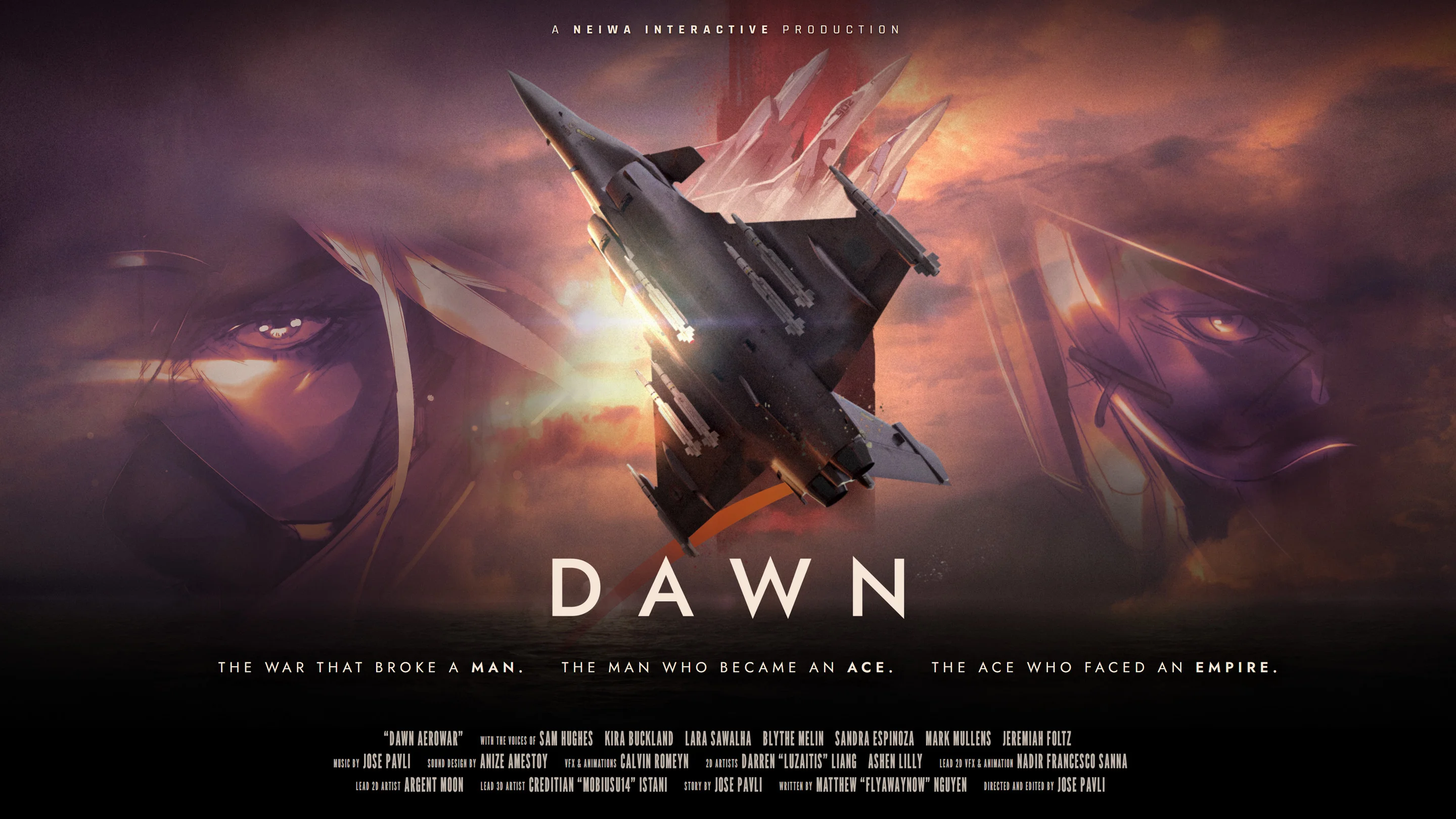
- Dawn Aerowar trailer analysis: The project presents an interactive animated war story, not a conventional flight simulator.
- Visual identity: 3D aircraft and environments contrast with 2D illustrated character presentation.
- Narrative focus: Zodiac 1’s final mission moves across the Northern Front, the Strait, Aegis Sea, and the capital.
- Interactive format: Cinematic mode, episode selection, and map-based chapter browsing support the viewing experience.
- Release context: The Windows Steam version is planned for November 10, 2026.
Dawn Aerowar Trailer Analysis: Core Identity
Dawn Aerowar trailer analysis begins with its unusual format. The project is positioned as an interactive animated war story that combines 3D animation, 2D artwork, full voice acting, original music, and chapter-based viewing. Its trailers are best understood as showcases of cinematic direction rather than traditional gameplay demonstrations.
The central promise is a dramatic aerial narrative following Zodiac 1 during a decisive final mission. The presentation emphasizes aircraft movement, pilot perspective, radio communication, wartime scale, and character emotion. That combination gives Dawn Aerowar a hybrid identity: part animated feature, part interactive story archive, and part navigable episode experience.
| Feature | Trailer implication | Why it matters |
|---|---|---|
| 3D animation | Aircraft, battles, and environments receive dimensional movement | Establishes scale and cinematic flight direction |
| 2D artwork | Characters use a contrasting illustrated presentation | Creates a distinct visual identity for pilots and dialogue scenes |
| Full voice acting | Spoken performances support the war drama | Strengthens character focus and radio-driven storytelling |
| Interactive viewing | Viewers can browse modes, episodes, and chapters | Adds navigation without requiring traditional combat systems |
| Original soundtrack | Music supports aerial tension and emotional transitions | Helps connect action scenes with the wider war narrative |
Aerial Scale
Large aircraft formations, battle zones, and changing viewpoints make the conflict feel broader than a single cockpit encounter.
Character Contrast
2D character art separates personal drama from the 3D aircraft and environments.
Mission Framing
Zodiac 1’s final operation gives the trailer material a clear narrative direction.
Interactive Film
Chapter selection and cinematic viewing organize the story without turning it into a conventional flight game.
Read the trailer as a visual pitch for a war film with interactive navigation. Judging it only by flight-simulator standards misses the project’s primary storytelling goal.
Visual Language and Camera Direction
The strongest visual feature is the contrast between three-dimensional aerial action and two-dimensional character presentation. This separation allows each part of the story to communicate differently. Aircraft scenes can prioritize speed, altitude, formation, and battlefield geography, while character scenes can focus on identity, expression, and dramatic pauses.
Cockpit viewpoints are particularly important because they connect the large-scale conflict to the individual pilot. Instruments, framing, and interior perspectives can make the mission feel immediate without requiring a complex aircraft simulation model. The cockpit becomes a narrative space where radio transmissions, orders, and reactions meet.
| Visual element | Primary role | Expected viewer response |
|---|---|---|
| Wide aerial shots | Show the scale of the war and movement between aircraft | Sense of distance, danger, and military scope |
| Cockpit framing | Place attention on the pilot and mission information | Greater intimacy and urgency |
| 2D portraits | Highlight characters during dialogue or dramatic beats | Stronger recognition of personality and rivalry |
| Aircraft close-ups | Emphasize design, motion, and mechanical detail | Appreciation for the project’s aviation focus |
| Transitional shots | Link locations and episodes | Clearer movement through the campaign |
The trailers also suggest a film-like camera language. Dynamic framing, composed sky shots, and dramatic transitions help the project feel authored rather than purely systems-driven. The action is not presented only as a sequence of controls or objectives; it is arranged to create rhythm, anticipation, and emotional escalation.
Focus on how the camera switches between wide battlefield geography, cockpit pressure, and character-focused imagery. These transitions reveal more about Dawn Aerowar’s identity than a simple list of features.
Wide Battlefield Composition
Use of distance and open sky can communicate the scale of the conflict before the story returns to an individual pilot.
Cockpit Intimacy
Interior shots narrow the perspective and make radio traffic, instruments, and pilot reactions more important.
Illustrated Character Beats
The 2D presentation gives dialogue and emotional moments a visual treatment separate from the action scenes.
Story Route and Trailer Context
The story follows Zodiac 1 through a final mission during the closing stage of a major war. The route crosses several important theaters, beginning at the Northern Front, continuing through the Strait and Aegis Sea, and eventually moving toward the capital.
This structure gives the trailer a natural escalation. The Northern Front can establish the military situation, while the Strait and Aegis Sea expand the operation into larger and more dangerous spaces. The movement toward the capital provides a clear sense of direction and prepares the story for its final stage.
| Story stage | Narrative function | Trailer analysis focus |
|---|---|---|
| Final mission setup | Establishes Zodiac 1’s central assignment | Mission briefings, aircraft preparation, and opening tension |
| Northern Front | Introduces the wider wartime situation | Scale of the aerial conflict and initial operational pressure |
| Strait | Moves the mission into a constrained route | Geography, interception risk, and changing camera perspectives |
| Aegis Sea | Expands the operation across open water | Long-range movement, formations, and atmospheric scale |
| Capital approach | Brings the mission toward its decisive stage | Escalation, opposing forces, and unresolved story stakes |
The character lineup also supports this structure. Zodiac 1 stands at the center of the mission, while the Imperial Ace pilots Reaper, Freya, and Miracle represent the opposing pilot presence. Their inclusion gives the aerial conflict a personal dimension. The war is not only a map-wide struggle; it is also shaped by the pilots who meet within it.
Identify the Mission Hook
Start with Zodiac 1’s final mission. Ask what must be protected, delivered, or completed, and how that assignment frames the rest of the story.
Track the Geographic Movement
Follow the route from the Northern Front through the Strait and Aegis Sea toward the capital. Location changes should signal rising stakes.
Separate Factions and Pilots
Note the difference between Zodiac 1’s mission unit and the Imperial Ace lineup of Reaper, Freya, and Miracle.
Connect Action to Character Drama
Compare wide combat imagery with cockpit and dialogue scenes to see how the trailer balances military scale and personal conflict.
Reserve Final Judgment
Treat the trailer as a setup for the complete 12-episode experience rather than a full explanation of the ending or lore.
The available presentation establishes the mission route and major pilot roles, but it does not confirm every plot resolution. Avoid presenting trailer setup as a complete ending explanation.
Sound, Voice Acting, and Atmosphere
Sound is a major part of the project’s war-film identity. English voice acting supports the main cast, while radio transmissions can connect pilots, commands, and battlefield events. This approach gives the aerial scenes a sense of purpose: aircraft movement becomes part of a conversation-driven operation rather than isolated spectacle.
The original soundtrack is also positioned as a substantial component, with approximately 90 minutes of music across 34 tracks. That scale suggests a production designed to use music throughout its nearly two-hour runtime and 12-episode structure. The soundtrack can therefore serve as a bridge between combat intensity, character scenes, and quieter transitions.
| Audio layer | Function in the experience | Analysis point |
|---|---|---|
| English voice acting | Delivers character identity and dramatic dialogue | Listen for how pilots are distinguished through performance |
| Radio transmissions | Explains orders, warnings, and mission developments | Connects action with narrative information |
| Original score | Shapes tension, momentum, and emotional emphasis | Compare musical intensity across locations and scenes |
| Aircraft sound effects | Adds physical presence to flight sequences | Supports immersion without defining the entire experience |
| Ambient battlefield sound | Establishes danger and wartime atmosphere | Gives scale to scenes outside direct dialogue |
The combination of voice, music, and aircraft sound should be read as cinematic layering. Each element has a different responsibility. Radio dialogue can clarify the mission, music can build emotion, and mechanical sound can make the aircraft feel present within the scene.
Trailer Analysis Checklist:
- Identify the difference between 3D aerial scenes and 2D character scenes
- Track Zodiac 1's route across the major theaters of war
- Note how cockpit framing changes the emotional perspective
- Listen for radio transmissions that clarify mission stakes
- Compare music, aircraft sound, and dialogue during major transitions
The English performance is the original voice presentation, while subtitles are listed for English, French, Italian, German, and Spanish audiences.
Interactive Viewing and Release Context
Dawn Aerowar’s interactivity is designed around how the story is watched and organized. The available feature outline includes Cinematic mode, episode selection, and a map interface for choosing chapters. These functions support replay and navigation, but they should not be mistaken for confirmed combat, leveling, equipment, or progression systems.
That distinction is essential when analyzing trailers. A flight-focused visual sequence may look like gameplay at first glance, yet the project’s stated structure centers on animated storytelling. The interactive layer gives viewers control over access and presentation rather than promising a traditional aircraft-management loop.
| Interactive feature | Practical use | What it does not establish |
|---|---|---|
| Cinematic mode | Presents the story as a guided animated experience | Does not confirm a full flight-simulation model |
| Episode selection | Lets viewers choose available story chapters | Does not imply branching story choices |
| Map navigation | Provides a visual way to browse locations or chapters | Does not confirm an open-world map |
| Scene revisiting | Supports returning to previously viewed material | Does not confirm unlockable equipment or upgrades |
| Controller support | Offers an alternative navigation method | Does not establish action-focused controls |
The planned release context is also straightforward. Official information lists a Windows Steam release planned for November 10, 2026. The project supports keyboard and mouse navigation as well as gamepad input, with English voice acting and multilingual subtitles.
Watch the trailer once for atmosphere, a second time for geographic movement, and a third time for character and audio details. This reveals the film structure more clearly than focusing only on aircraft action.
First Pass: Atmosphere
Examine color, lighting, aircraft movement, and the balance between wide shots and cockpit perspectives.
Second Pass: Story
Track Zodiac 1, the mission route, opposing Imperial Aces, and any radio exchanges that establish stakes.
Third Pass: Craft
Study editing rhythm, 2D and 3D transitions, music cues, voice performances, and chapter-like pacing.
Official release information is available through the Dawn Aerowar official website and the Dawn Aerowar Steam page. Use those pages for the latest schedule, platform details, and launch updates.
FAQ: Dawn Aerowar Trailer Analysis
Q: What is the main conclusion of this Dawn Aerowar trailer analysis?
The trailer presents Dawn Aerowar as an interactive animated war story built around cinematic aerial action, 2D character art, voice acting, radio drama, and chapter-based viewing rather than a conventional flight simulator.
Q: Is Dawn Aerowar a traditional flight combat game?
The available information positions it as an interactive animated feature. It includes aviation-focused scenes and interactive navigation, but the confirmed design centers on watching, selecting episodes, and revisiting chapters rather than combat progression.
Q: Who is the main character in Dawn Aerowar?
Zodiac 1 is the central pilot and mission unit connected to the final operation. The opposing Imperial Ace lineup includes Reaper, Freya, and Miracle.
Q: How many episodes and how much content does Dawn Aerowar include?
The project is planned as 12 episodes with nearly two hours of content. Its story route moves through the Northern Front, the Strait, Aegis Sea, and the capital.
Dawn Aerowar’s trailer succeeds when viewed as a cinematic introduction to a wartime journey. Its defining strengths are visual contrast, pilot-focused drama, geographic progression, and interactive story access.