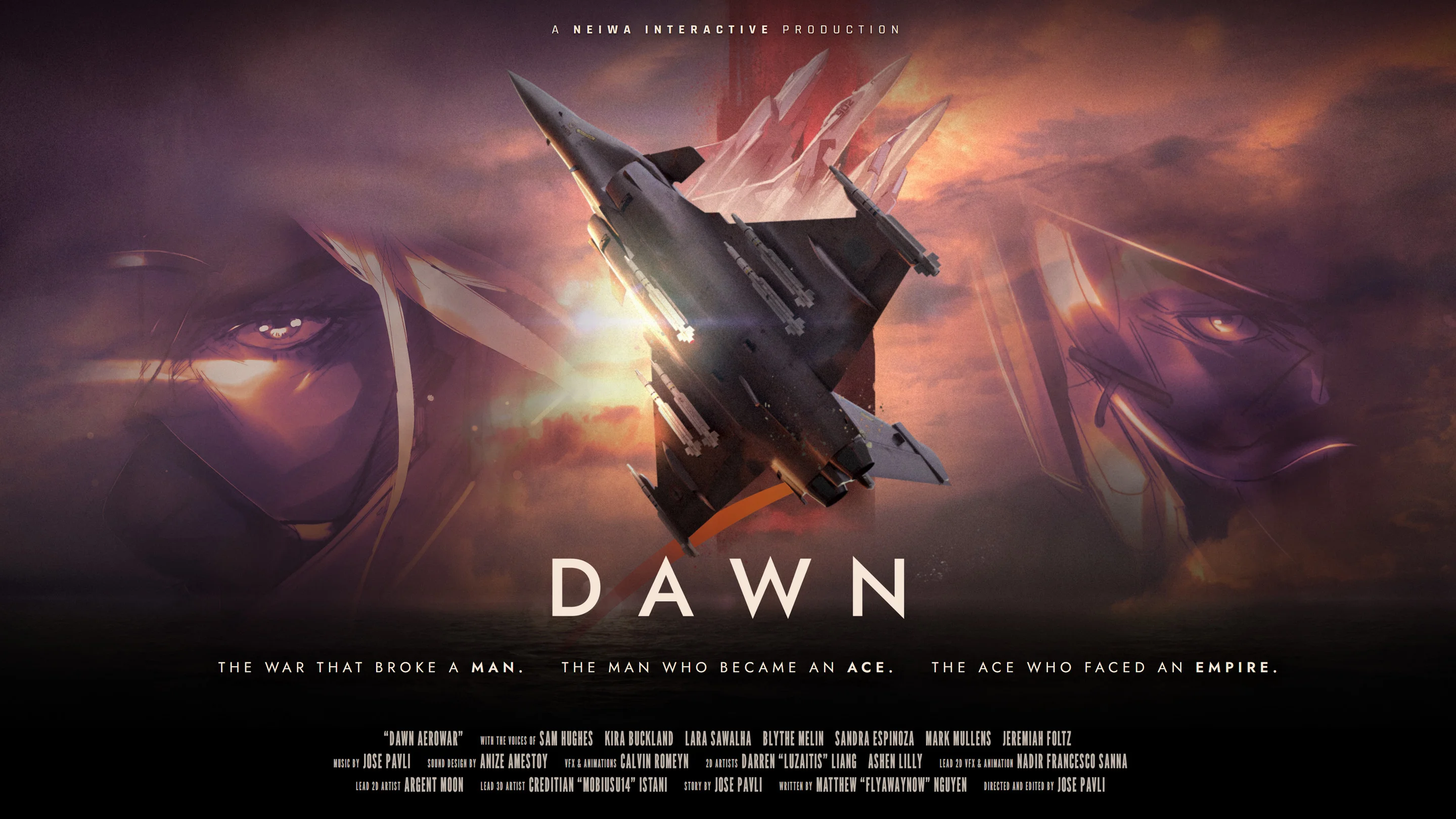
- Dawn Aerowar soundtrack: An original score planned at approximately 90 minutes across 34 tracks.
- Composer: Jose Pavli leads the music direction for the animated war story.
- Musical identity: Orchestral writing, choral color, dramatic tension, and cinematic aerial atmosphere.
- Release context: The soundtrack is tied to a 12-episode interactive animated feature planned for November 10, 2026.
- Listening approach: Follow the story structure instead of expecting a conventional battle-game music loop.
Dawn Aerowar Soundtrack Overview
The Dawn Aerowar soundtrack is an original cinematic score designed for an interactive animated war story rather than a traditional flight simulator. Official project information describes approximately 90 minutes of music distributed across 34 tracks. The score supports a feature-length presentation with 12 episodes, full English voice acting, aerial combat imagery, radio communication, and a narrative centered on a final mission.
The music is best understood as part of the film’s storytelling system. It is expected to help establish military scale, emotional pressure, cockpit tension, and the changing atmosphere of the mission. Because Dawn Aerowar combines 3D aircraft animation with 2D character artwork, the soundtrack has to support both large action sequences and more personal character-focused moments.
Original Score
The project uses original music created for its animated war narrative, rather than a collection of unrelated licensed songs.
34 Tracks
The planned soundtrack contains 34 tracks, giving the feature room for recurring themes, transitions, and scene-specific cues.
90 Minutes
The published music length is approximately 90 minutes, closely matching the scale of the nearly two-hour animated experience.
Story Integration
The score is built to accompany missions, radio exchanges, character tension, and movement through multiple theaters of war.
Treat the soundtrack as a narrative component. Its value is not only in standalone melodies, but also in how it shapes the pacing and emotional weight of each episode.
| Soundtrack Detail | Confirmed Information |
|---|---|
| Composer | Jose Pavli |
| Track count | 34 tracks |
| Approximate music length | 90 minutes |
| Associated work | Interactive animated war story |
| Episode structure | 12 episodes |
| Planned release date | November 10, 2026 |
For the latest project information, consult the official Dawn Aerowar website and its official Steam page.
How the Music Supports the Story
Dawn Aerowar follows Zodiac 1 during a decisive final mission connected to the war between the Free Nations and the Saal'Runa Empire. The route moves through the Northern Front, the Strait, the Aegis Sea, and ultimately the capital. This structure gives the score several distinct dramatic environments to support.
Rather than assigning the music to a conventional gameplay loop, the soundtrack is organized around cinematic progression. A track may help introduce a location, intensify an encounter, underline a radio transmission, or give a character scene enough space to develop. The music therefore belongs to the rhythm of the episodes and mission stages.
| Story Area | Likely Musical Function | Listening Focus |
|---|---|---|
| Northern Front | Establishes the scale and seriousness of the conflict | Military atmosphere and opening tension |
| The Strait | Increases movement and operational pressure | Momentum, danger, and changing objectives |
| Aegis Sea | Expands the sense of geographic and strategic scale | Open-airal atmosphere and cinematic transition |
| The Capital | Brings the central operation toward its final stage | Emotional payoff and narrative weight |
| Character scenes | Supports pilots, relationships, and personal stakes | Theme development and quieter contrast |
The project’s visual design also influences how the score should be interpreted. Three-dimensional aircraft, environments, and aerial action can benefit from broad orchestral movement, while hand-drawn character sequences may call for more focused thematic writing. The contrast between these visual modes gives the soundtrack room to shift between scale and intimacy.
The available information confirms the planned track count and approximate duration, but it does not provide a public song-by-song tracklist or confirmed standalone streaming release. Avoid treating unnamed tracks as officially titled.
| Presentation Element | Role in the Music Experience |
|---|---|
| 3D aircraft animation | Supports large-scale motion, aerial danger, and cinematic action |
| 2D character artwork | Creates space for personal themes and emotional contrast |
| Full voice acting | Requires music to support dialogue without overwhelming it |
| Radio transmissions | Adds military context and pacing between major scenes |
| Interactive chapter selection | Allows listeners to revisit story sections through the viewing structure |
Musical Style and Core Themes
The published description of Dawn Aerowar emphasizes orchestral and choral qualities. That combination fits the project’s war-film identity: orchestral writing can communicate scale and motion, while choral color can add gravity, ceremony, or a sense of historical consequence. The score’s role is not limited to depicting aircraft; it also helps frame the conflict as a major human and political event.
Several broad musical themes are useful when organizing the soundtrack. These are descriptive listening categories rather than official track names. They help explain how a 34-track score can serve a long-form animated story without inventing details that have not been published.
Aerial Tension
Music for flight, interception, pursuit, and rapidly changing danger. Expect this category to emphasize motion and pressure.
War-Time Scale
Broad orchestral and choral writing can frame the conflict, its nations, and the importance of the final mission.
Character Emotion
More restrained passages can support Zodiac 1, the Imperial aces, and the personal consequences behind the operation.
The score should also be considered alongside the three Imperial Ace pilots: Reaper, Freya, and Miracle. The available material identifies them as important opposing figures, but it does not confirm individual musical themes for each character. A careful soundtrack guide can discuss their narrative role while avoiding unsupported claims about leitmotifs or named character tracks.
| Musical Category | Confirmed or Supported Use | What Not to Assume |
|---|---|---|
| Orchestral score | Matches the cinematic war-film presentation | Specific instruments for individual tracks |
| Choral elements | Listed as part of the musical identity | A complete choir roster or language |
| Flight tension | Fits aerial action and mission progression | Exact placement of every action cue |
| Character themes | Compatible with the cast-focused story | Confirmed themes for Reaper, Freya, or Miracle |
| Radio atmosphere | Supports the military presentation | A separate official radio-drama album |
Listen for contrast: wide, forceful passages should be read alongside the aerial conflict, while restrained moments may reveal the personal cost behind the mission.
The most reliable approach is to separate confirmed facts from interpretation. The project confirms the original score, composer, approximate length, and track count. The emotional categories above explain how those facts may function within the story without presenting speculation as an official track guide.
Step-by-Step Soundtrack Guide
The soundtrack is easiest to explore through the same broad progression used by the animated feature. Dawn Aerowar is planned as a 12-episode work lasting nearly two hours, so a chronological approach gives the music a clear dramatic shape.
Start with the Project Context
Begin with the official premise, visual style, and episode structure. Dawn Aerowar combines 3D animation, 2D artwork, voice acting, and interactive viewing, so the score should be approached as part of a cinematic presentation.
Identify the Mission Setting
Place the music within Zodiac 1’s final mission. The Northern Front, the Strait, the Aegis Sea, and the capital provide the main geographic stages for understanding changes in scale and tension.
Separate Action from Character Focus
Mark the difference between aerial conflict, military transitions, radio scenes, and character moments. This makes recurring moods easier to notice without assigning unconfirmed titles or themes.
Compare the Episode Progression
Use the 12-episode structure to track how the score moves from setup to escalation and toward the final stage of the operation. Pay attention to changes in intensity and emotional emphasis.
Check Official Updates Before Sharing Track Names
Review the official website and Steam listing for future soundtrack announcements. Use only published titles when creating a tracklist or linking to an audio release.
A useful personal playlist can use labels such as “mission setup,” “aerial tension,” “character focus,” and “finale atmosphere” until official track titles are published.
| Listening Stage | Main Question | Useful Evidence |
|---|---|---|
| Setup | What conflict and mission are being introduced? | Opening visuals, narration, radio context |
| Escalation | How does the music increase pressure? | Faster pacing, denser orchestration, repeated tension |
| Transition | How does the story move between locations? | New setting, travel sequence, change in mood |
| Character focus | Which personal stakes become clearer? | Dialogue, portraits, quieter scene direction |
| Final stage | How does the score frame the mission’s importance? | Capital setting, climax, emotional resolution |
Soundtrack Research Checklist:
- Verify the official composer credit for Jose Pavli
- Record the confirmed 34-track and approximately 90-minute details
- Separate published track names from descriptive listening categories
- Check the official website for soundtrack announcements
- Avoid claiming an unconfirmed streaming or download release
This method also works for wiki editors. It keeps the article useful before launch while leaving room to add official track names, audio links, and episode-by-episode details when the project publishes them.
Availability, Languages, and FAQ
As of October 26, 2026, Dawn Aerowar is planned for release on Windows through Steam on November 10, 2026. The project is described as an interactive animated feature with English voice acting and subtitles in English, French, Italian, German, and Spanish.
The soundtrack itself is associated with the main work, but a separate public album page, full tracklist, or confirmed streaming destination is not established in the supplied official information. For that reason, the safest wiki practice is to document the confirmed production details and link readers to official announcements rather than promising access that has not been announced.
| Access Detail | Current Information |
|---|---|
| Main release platform | Windows through Steam |
| Planned date | November 10, 2026 |
| Voice language | English |
| Subtitle languages | English, French, Italian, German, Spanish |
| Soundtrack format | Original score connected to the animated feature |
| Public tracklist | Not confirmed in the available information |
Update this page when the official team publishes track titles, an album link, composer notes, or episode-specific music credits. Until then, keep the 34-track and 90-minute figures clearly identified as the currently published soundtrack summary.
Q: How many tracks are in the Dawn Aerowar soundtrack?
The official project information describes an original soundtrack with 34 tracks and approximately 90 minutes of music.
Q: Who composed the Dawn Aerowar soundtrack?
Jose Pavli is credited with creating the project’s original music. The available information does not provide a complete list of individual track credits.
Q: Is the Dawn Aerowar soundtrack available as a separate album?
A confirmed public album, streaming page, or standalone download link is not established in the available information. Check the official website and Steam page for future announcements.
Q: What style of music does Dawn Aerowar use?
The score is presented as cinematic original music with orchestral and choral qualities, supporting aerial action, war-time scale, radio scenes, and character-focused moments.
The best authoritative references are the Dawn Aerowar official website, the official Chinese-language page, and the Windows Steam listing. These pages should remain the primary destinations for release changes and future soundtrack announcements.