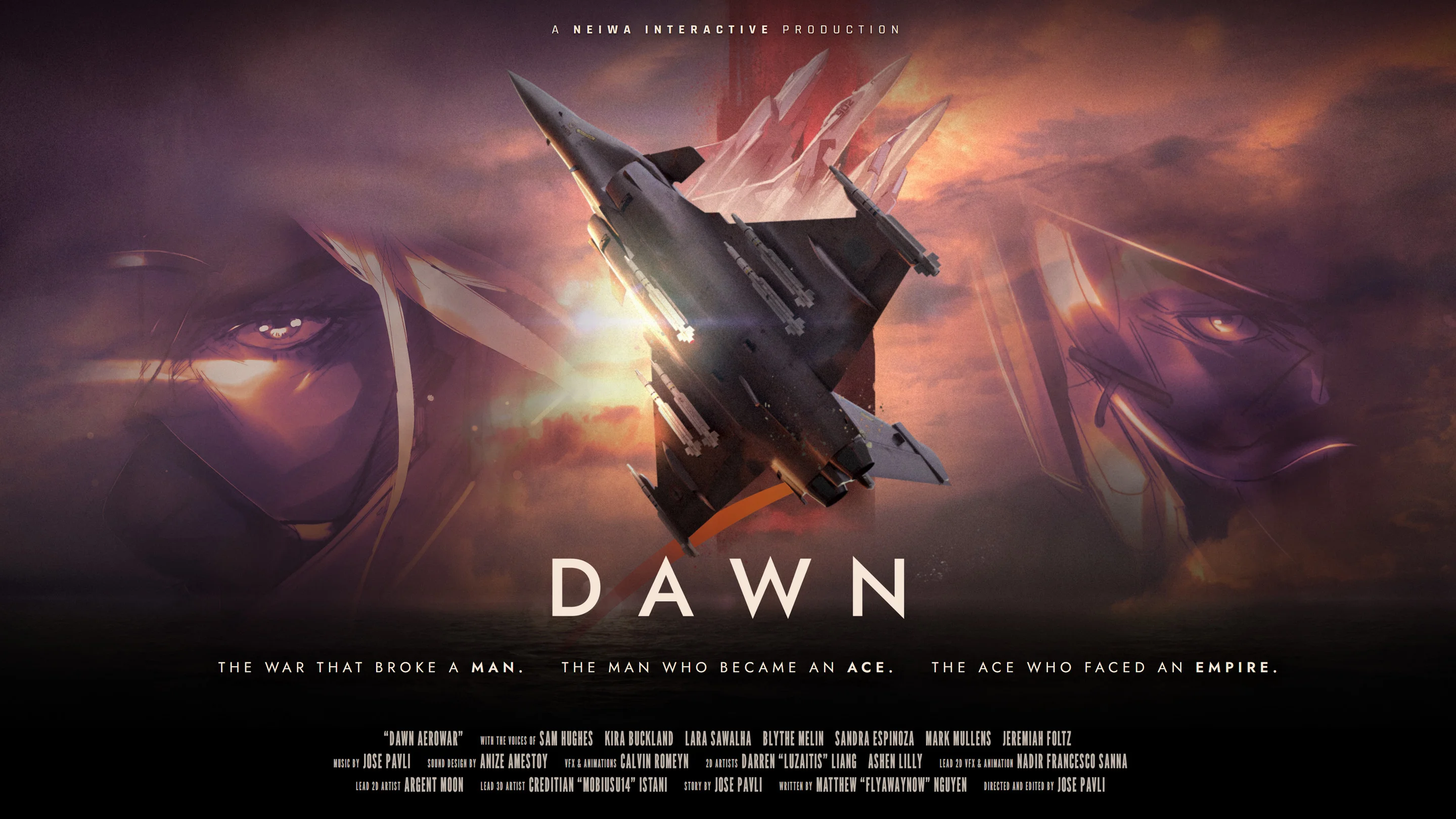
- Dawn Aerowar announcement trailer analysis centers on cinematic storytelling rather than traditional flight combat.
- Visual identity combines 3D aircraft animation, 2D character art, cockpit staging, and dramatic war-film editing.
- Story focus follows Zodiac 1 through a final mission across the Northern Front, Strait, Aegis Sea, and capital.
- Format presents a nearly two-hour animated work divided into 12 episodes with interactive viewing features.
- Release context points to a planned Windows Steam launch on November 10, 2026.
What the Dawn Aerowar Announcement Trailer Establishes
Dawn Aerowar announcement trailer analysis begins with one important distinction: this project is presented as an interactive animated war story, not a conventional flight simulator. Its announcement materials combine feature-length storytelling, 3D aerial sequences, 2D artwork, voice acting, and chapter-based interaction.
The trailer’s main purpose is therefore to establish tone and format. Rather than promising a traditional combat loop, it introduces a cinematic experience built around pilots, aircraft, radio communication, military pressure, and a final wartime operation.
| Trailer Element | What It Communicates | Why It Matters |
|---|---|---|
| 3D aircraft animation | Large-scale aerial movement and wartime action | Establishes the visual scale of the conflict |
| 2D character art | Individual identities and emotional focus | Balances spectacle with character presentation |
| Cockpit viewpoints | A closer connection to pilots and instruments | Reinforces immersion without requiring flight simulation |
| Full voice acting | Dialogue-driven narrative progression | Supports the animated-film structure |
| Chapter presentation | A story divided into 12 episodes | Makes the work easier to browse and revisit |
| Original soundtrack | Dramatic atmosphere and emotional pacing | Connects aerial action with film-style storytelling |
The strongest announcement is the project’s hybrid identity. Dawn Aerowar uses the language of aviation fiction and war cinema, but its interactive features are primarily designed for watching, selecting, and revisiting story content.
Read the announcement trailer as a presentation of tone, world, and cinematic structure. It should not be judged by the standards of a traditional flight combat game.
Aerial Scale
3D aircraft and battle environments provide the large-scale visual foundation.
Character Focus
2D artwork and voice performances keep the pilots central to the narrative.
War Drama
The final mission gives the story a clear sense of urgency and consequence.
Interactive Viewing
Episode selection and map navigation make the animated feature easier to explore.
Visual Style and Cinematic Language
The visual identity is built on contrast. Aircraft and environments use a three-dimensional presentation, while character-focused material uses a hand-drawn 2D style. This separation allows Dawn Aerowar to shift between the mechanical scale of aerial warfare and the personal perspective of its pilots.
The contrast also helps the announcement communicate its intended rhythm. Aerial scenes can emphasize distance, speed, formations, and battle zones. Character scenes can slow the pace and give faces, dialogue, and relationships greater weight.
| Visual Layer | Main Function | Expected Viewer Effect |
|---|---|---|
| Aircraft and environments | Depict flight, battle zones, and military movement | Creates scale and momentum |
| 2D pilot presentation | Highlight character identity and emotion | Makes the cast easier to remember |
| Cockpit interiors | Place attention on instruments and pilots | Creates a more intimate viewpoint |
| Radio transmissions | Connect characters across the mission | Adds tactical and dramatic context |
| Cinematic transitions | Link locations and story beats | Gives the work a film-like flow |
The cockpit is especially important to the project’s visual language. It acts as a bridge between spectacle and character drama. Exterior shots can show the conflict from a broad perspective, while cockpit scenes place the audience near the people responsible for surviving it.
The original soundtrack supports this same structure. The official project information describes approximately 90 minutes of music across 34 tracks, suggesting that musical atmosphere is a major part of the presentation rather than a minor background feature.
The 3D-versus-2D contrast is not merely a technical choice. It separates the scale of the war from the emotional perspective of the people inside it.
A useful way to understand the announcement is to divide its visual promise into four layers:
- Motion: aircraft movement and changing battle environments.
- Perspective: exterior aerial views compared with cockpit interiors.
- Identity: illustrated pilots, ace reputations, and factional presentation.
- Atmosphere: voice acting, radio traffic, music, and controlled editing.
These layers support a cinematic work that can feel expansive without requiring traditional progression systems such as equipment upgrades, character levels, or combat builds.
Story Signals, Locations, and Mission Structure
The announcement establishes a focused wartime narrative centered on Zodiac 1 and a final mission. The operation moves through several theaters, beginning at the Northern Front and continuing through the Strait, the Aegis Sea, and the capital.
This route gives the story a clear geographic progression. Each location can function as more than a backdrop: the Northern Front introduces the conflict, the Strait creates a transitional pressure point, the Aegis Sea expands the scale of the operation, and the capital represents the mission’s final objective.
| Story Stage | Location or Focus | Narrative Function |
|---|---|---|
| Opening operation | Northern Front | Establishes the conflict and mission conditions |
| Mid-route pressure | The Strait | Moves the operation into a more constrained theater |
| Expanded conflict | Aegis Sea | Broadens the scale of the aerial campaign |
| Final approach | The capital | Brings the mission toward its decisive stage |
| Character opposition | Imperial aces | Gives Zodiac 1 a recognizable enemy lineup |
The main opposing pilots are identified as Reaper, Freya, and Miracle, three Imperial aces connected to the larger aerial conflict. Their role is not simply to provide opponents; their titles and reputations help the announcement communicate a world where individual pilots carry symbolic importance.
The story setup also includes a mysterious weapon and a larger conflict between the Free Nations and the Saal'Runa Empire. These elements create a traditional war-drama framework: a protagonist unit receives a critical assignment, moves through contested territory, and faces elite opposition before reaching a major political or military center.
The available announcement information establishes the mission route and major factions, but it does not confirm the final outcome. Avoid treating the ending as known before the full story releases.
The planned structure is equally important. Dawn Aerowar is described as nearly two hours long and divided into 12 episodes. That format suggests a story designed for both continuous viewing and shorter chapter sessions.
| Format Detail | Confirmed Information | Reading of the Format |
|---|---|---|
| Total runtime | Nearly 2 hours | Feature-length viewing experience |
| Episode count | 12 episodes | Divided narrative progression |
| Central unit | Zodiac 1 | Main mission and viewpoint |
| Enemy lineup | Reaper, Freya, Miracle | Imperial ace opposition |
| Main route | Northern Front to capital | Escalating geographic journey |
How to Read the Interactive Viewing Format
Dawn Aerowar’s interactivity is designed around navigation and presentation. The available information identifies Cinematic mode, episode selection, and map-based chapter browsing as important features. These systems organize the animated story instead of turning it into a conventional combat progression game.
Follow this sequence when exploring the announced format:
Choose a Viewing Mode
Begin with Cinematic mode when you want the most guided presentation. This option is intended to emphasize atmosphere, scene composition, dialogue, and film-like pacing.
Select an Episode
Use the episode structure to choose a specific part of the story. The 12-episode layout should make it easier to pause between major sections or return to a memorable sequence.
Navigate the Story Map
Use the map interface to browse available chapters and locations. The map connects the narrative route with the major theaters introduced by the project.
Watch the Chapter
Follow the animated sequence with attention to aircraft movement, cockpit framing, voice performances, radio exchanges, and musical transitions.
Revisit Key Sections
Return to earlier episodes or chapters when comparing character introductions, mission stages, visual motifs, or changes in the wartime situation.
| Interactive Feature | Best Use | What It Does Not Claim |
|---|---|---|
| Cinematic mode | Guided story viewing | It does not indicate a conventional combat mode |
| Episode selection | Starting a specific chapter | It does not confirm branching story paths |
| Map navigation | Revisiting locations and sections | It does not confirm free-flight exploration |
| Chapter replay | Comparing scenes and story beats | It does not confirm player-created missions |
This distinction matters for readers searching for gameplay information. The project can include interactive controls and gamepad support while still functioning primarily as an animated narrative experience. Its interaction is best understood as viewer-directed story access.
The planned Windows Steam release is listed for November 10, 2026. Platform information identifies Windows PC distribution through Steam, with keyboard, mouse, and controller support described for navigation and interactive viewing.
Start with Cinematic mode for the intended first impression, then use episode and map selection to revisit specific story sections afterward.
Trailer Analysis Checklist and FAQ
Use this checklist to evaluate the announcement presentation without confusing Dawn Aerowar with a traditional flight-action title.
Analysis Checklist:
- Identify how 3D aircraft scenes establish scale and movement
- Compare 2D character art with the three-dimensional environments
- Track the mission route from the Northern Front toward the capital
- Note how cockpit scenes and radio transmissions focus attention on the pilots
- Separate confirmed format details from speculation about the final outcome
The official Dawn Aerowar website provides the project’s core presentation, release information, story overview, soundtrack details, and language options. The official Steam page provides the planned Windows distribution information and current store listing.
| Category | Confirmed Direction |
|---|---|
| Voice acting | English voice performances |
| Subtitles | English, French, Italian, German, and Spanish |
| Music | Approximately 90 minutes across 34 tracks |
| Release plan | Windows through Steam |
| Planned date | November 10, 2026 |
| Project identity | Interactive animated war story |
When updating this analysis, preserve the difference between confirmed announcement details and later information revealed through official episodes, trailers, or release notes.
Q: What is the main focus of the Dawn Aerowar announcement trailer analysis?
The analysis focuses on the project’s cinematic identity, including 3D aircraft animation, 2D character art, cockpit viewpoints, voice acting, war-story structure, and interactive viewing features.
Q: Is Dawn Aerowar presented as a traditional flight simulator?
No. The available project information presents Dawn Aerowar as an interactive animated war story. Its interaction centers on Cinematic mode, episode selection, map navigation, and chapter replay rather than confirmed flight combat systems.
Q: What story does the announcement establish?
The story follows Zodiac 1 on a final mission that moves from the Northern Front through the Strait and Aegis Sea toward the capital, with Imperial aces Reaper, Freya, and Miracle connected to the opposing side.
Q: When is Dawn Aerowar planned to release?
The current plan lists a Windows Steam release for November 10, 2026. Release details may change, so readers should check the official website and Steam page for updates.