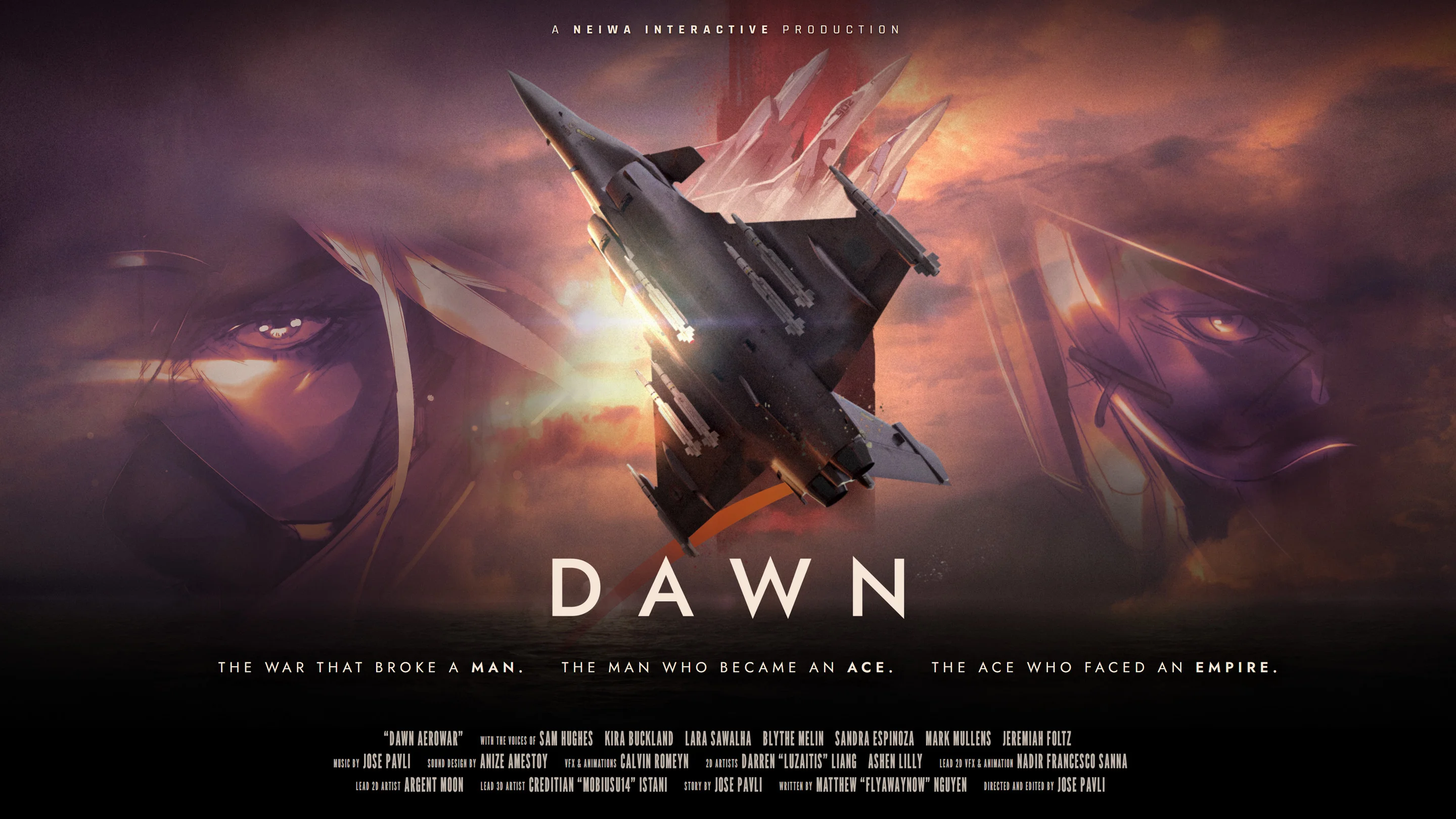
- Dawn Aerowar teaser analysis focuses on its animated war-film identity rather than traditional flight gameplay.
- Visual direction combines 3D aircraft animation, 2D character art, cockpit perspectives, and cinematic editing.
- Story setup follows Zodiac 1 during a final mission across several wartime theaters.
- Structure includes 12 episodes and nearly two hours of English-voiced animated content.
- Interactive features organize viewing through Cinematic mode, episode selection, and map-based chapter navigation.
Dawn Aerowar Teaser Analysis: Core Identity
Dawn Aerowar teaser analysis begins with its format. The project is best understood as an interactive animated war story, not a conventional flight simulator or combat game. Its central appeal comes from the combination of 3D aerial animation, 2D artwork, full voice acting, radio-driven war drama, and chapter-based viewing.
The official presentation frames the experience around a decisive mission involving Zodiac 1. The aircraft and battle environments provide the visual scale, while character scenes and voice performances give the conflict a dramatic, film-like structure. This distinction matters because the teaser should be read as a preview of tone, worldbuilding, and cinematic presentation rather than as a demonstration of traditional progression systems.
3D Aerial Action
Aircraft, battle zones, and large-scale wartime movement are presented through 3D animation.
2D Character Art
Hand-drawn character presentation adds contrast and gives the cast a distinct visual identity.
Voice-Acted Drama
English performances support the pilots, radio exchanges, and emotional progression of the story.
Interactive Viewing
Cinematic mode, episode selection, and map navigation organize how the animated feature is watched.
Teaser reading guide:
- Treat the aircraft imagery as part of the story’s cinematic language.
- Look for contrasts between wide aerial compositions and close cockpit viewpoints.
- Read the opposing pilots as narrative forces, not simply as gameplay opponents.
- Pay attention to the shift from military scale to personal character moments.
- Use the official Dawn Aerowar website for current presentation details.
| Teaser Element | Likely Narrative Function | What to Watch For |
|---|---|---|
| Aircraft formations | Establishes the scale of the conflict | Positioning, movement, and changing battle pressure |
| Cockpit scenes | Grounds the war story through individual pilots | Radio communication, instruments, and reaction shots |
| 2D portraits | Identifies major characters | Expressions, uniforms, and factional presentation |
| War-zone transitions | Connects the mission to a wider campaign | Northern Front, Strait, Aegis Sea, and capital references |
| Dramatic music | Builds tension and emotional momentum | Escalation before encounters or mission turning points |
The strongest way to interpret the teaser is as a promise of atmosphere and narrative scale. It introduces an animated war film with interactive access points, not a traditional aircraft progression loop.
Story Setup and Episode Structure
The story follows Zodiac 1 during a final mission at a critical stage of the war. The operation involves escorting a mysterious weapon while moving through contested regions connected to the conflict between the Free Nations and the Saal'Runa Empire.
The route gives the narrative a clear geographic progression. Rather than presenting disconnected action scenes, the structure moves through several theaters of war before reaching the capital. This journey helps the teaser establish momentum: the mission begins as a military operation, expands across multiple battle zones, and gradually approaches a larger confrontation.
| Story Stage | Location or Focus | Narrative Role |
|---|---|---|
| 1 | Final mission | Introduces Zodiac 1 and the central operation |
| 2 | Northern Front | Establishes the war’s immediate military pressure |
| 3 | The Strait | Moves the mission into a strategically important passage |
| 4 | Aegis Sea | Expands the scale of the aerial conflict |
| 5 | The capital | Brings the operation toward its final stage |
Establish the Mission
Begin with Zodiac 1 and the operation’s immediate objective. The final-mission framing gives the story urgency from the opening setup.
Track the Front Line
Follow the movement from the Northern Front into the Strait. These locations connect personal pilot decisions with the wider war.
Expand Across the Aegis Sea
Treat the Aegis Sea as a transition point where the mission grows in scale and the opposing forces become more prominent.
Identify the Character Conflicts
Watch how Zodiac 1’s mission intersects with the Imperial aces Reaper, Freya, and Miracle.
Prepare for the Capital Sequence
The approach to the capital functions as the story’s late-stage destination and connects the individual mission to the wider conflict.
The complete work is planned as 12 episodes with a runtime of nearly two hours. That structure supports both a feature-length viewing experience and shorter chapter-based sessions. It also explains why the project can serve viewers who want a continuous animated film as well as those who prefer selecting specific story sections.
This analysis covers the confirmed premise, locations, and character lineup. It does not assign an unverified ending, hidden betrayal, or final mission outcome to the story.
Characters, Aces, and Visual Conflict
The teaser’s character drama centers on Zodiac 1 and three Imperial Ace pilots: Reaper, Freya, and Miracle. Their names and positions immediately create a clear opposing-pilot structure. Zodiac 1 represents the central mission perspective, while the Imperial aces embody the elite forces standing against that operation.
This arrangement gives the aerial action a personal dimension. Aircraft movement can show the scale of the battle, but the pilot lineup gives those encounters identity. The teaser’s character value therefore comes from the contrast between the protagonist’s mission and the reputations of the opposing aces.
| Character | Confirmed Role | Faction or Position | Analysis Focus |
|---|---|---|---|
| Zodiac 1 | Central pilot and mission unit | Protagonist side | Mission pressure, perspective, and narrative continuity |
| Reaper | Imperial Ace pilot | Saal'Runa Empire | Threat presentation and elite opposition |
| Freya | Imperial Ace pilot | Saal'Runa Empire | Rival pilot identity and character contrast |
| Miracle | Imperial Ace pilot | Saal'Runa Empire | Opposing lineup and aerial conflict |
| Radio voices | Supporting narrative presence | War factions | Context, orders, urgency, and emotional framing |
Zodiac 1
The central viewpoint for the final mission. Zodiac 1 connects the episode route, aerial action, and larger story objective.
Imperial Aces
Reaper, Freya, and Miracle form the opposing ace lineup associated with the Saal'Runa Empire.
Radio Drama
Voice communication helps bridge the gap between aircraft action, military orders, and character emotion.
For teaser analysis, the most useful question is not which pilot is strongest. The confirmed materials do not provide a competitive ranking or combat-stat system. Instead, examine how the presentation differentiates the characters through framing, dialogue, uniforms, expressions, and their relationship to the mission.
The character design also supports the work’s hybrid format. Aircraft and environments can be rendered with three-dimensional scale, while close character moments can use a more illustrated style. This contrast gives the project a visual rhythm that shifts between war spectacle and animated drama.
Use the ace pilots as narrative markers. Their presence signals that Zodiac 1’s route is being shaped by named rivals and military personalities, not only anonymous enemy formations.
Interactive Viewing and Presentation Choices
Dawn Aerowar’s interaction is designed around how the story is viewed. The available information emphasizes Cinematic mode, episode selection, and map-based chapter navigation rather than combat upgrades, equipment trees, or character leveling.
That distinction helps explain the project’s unusual identity. The interactive layer provides control over access and replay, while the animated content remains the main attraction. Viewers can approach the work as a continuous film, select individual episodes, or revisit chapters through the map interface.
| Viewing Feature | Purpose | Best Use |
|---|---|---|
| Cinematic mode | Presents the story as a guided animated experience | First viewing and atmosphere-focused sessions |
| Episode selection | Opens individual parts of the 12-episode structure | Reviewing specific story sections |
| Map navigation | Connects chapters to locations and the mission route | Understanding the geographic progression |
| Scene revisiting | Makes earlier sections easier to access again | Character, radio, and visual detail review |
| PC controls and gamepad support | Provides flexible navigation input | Choosing a preferred viewing setup |
Teaser Analysis Checklist:
- Identify the difference between 3D aircraft scenes and 2D character scenes
- Track the route from the Northern Front toward the capital
- Note how Zodiac 1 and the Imperial aces are introduced
- Separate confirmed interactive viewing features from traditional game mechanics
- Compare the teaser tone with the planned 12-episode structure
A practical viewing method is to watch first for tone, then revisit for structure. On the first pass, focus on the music, pacing, aircraft scale, and emotional atmosphere. On a second pass, track locations, character appearances, radio context, and transitions between cinematic scenes.
The planned Windows Steam release is listed for November 10, 2026. The official Steam page is the most useful place to check the current release status and platform information.
Do not evaluate Dawn Aerowar only through conventional gameplay expectations. Its interaction is primarily a way to navigate and revisit an animated war narrative.
Soundtrack, Tone, and Final Assessment
Music is a major part of the project’s cinematic identity. The official information describes an original soundtrack of approximately 90 minutes and 34 tracks, created by Jose Pavli. The combination of orchestral writing, choral elements, aircraft sound design, and radio communication is intended to give the war story a broad emotional range.
The soundtrack should be considered alongside the visual structure. Large aerial sequences need scale and forward momentum, while cockpit scenes and character moments require space for dialogue and tension. A successful teaser therefore depends on how well it moves between spectacle, military urgency, and quieter character-focused passages.
| Presentation Layer | Main Contribution | Expected Effect |
|---|---|---|
| Orchestral score | Adds scale to battles and mission transitions | Heightens urgency and drama |
| Choral elements | Reinforce the mythic or historical weight of the conflict | Makes major moments feel larger |
| Radio dialogue | Delivers mission context and character reactions | Connects action to story |
| Aircraft sound design | Gives flight scenes physical presence | Strengthens immersion |
| 2D character presentation | Creates visual intimacy | Balances the aerial spectacle |
The strongest conclusion from the teaser material is that Dawn Aerowar occupies a space between an animated feature, an audio-visual war drama, and an interactive chapter viewer. Its appeal will likely depend on whether viewers value atmosphere, character conflict, military worldbuilding, and visual presentation more than traditional systems such as upgrades or competitive combat.
The project’s confirmed strengths include:
- A focused final-mission premise.
- A clear route across multiple wartime locations.
- A named cast of rival ace pilots.
- A combination of 3D aircraft scenes and 2D character art.
- Nearly two hours of content divided into 12 episodes.
- English voice acting with subtitles in English, French, Italian, German, and Spanish.
- An original soundtrack designed for cinematic pacing.
Dawn Aerowar is most compelling as an interactive animated war film. The teaser’s key promise is a layered cinematic journey built from pilots, radio drama, aerial scale, music, and chapter-based access.
Q: What is Dawn Aerowar teaser analysis mainly about?
It examines Dawn Aerowar as an interactive animated war story, focusing on its visual style, story premise, characters, soundtrack, and chapter-based viewing features rather than traditional flight-game systems.
Q: Is Dawn Aerowar a traditional flight simulator?
No. The confirmed presentation describes it as an animated feature with interactive viewing elements. It uses aircraft and aerial combat imagery, but the core experience centers on cinematic storytelling.
Q: How many episodes does Dawn Aerowar include?
The project is planned as 12 episodes with nearly two hours of total content.
Q: Who are the main pilots in Dawn Aerowar?
The central pilot is Zodiac 1. The opposing Imperial ace lineup includes Reaper, Freya, and Miracle.